How did Tintin become a cultural icon in France?
Why is Tintin an Icon of French-language Comics?
Created in 1929 by Belgian artist Georges Remi, aka Hergé, Tintin has become an essential figure in the world of comic books, with millions of copies sold worldwide. His thrilling adventures and lovable characters have marked several generations of readers, and he remains a major reference in Francophone culture. So, what makes Tintin unique and timeless?
A Universal and Timeless Hero
Tintin is a young Belgian reporter who travels around the world in search of scoops. What sets him apart from other comic book heroes is his simplicity and universal appeal. Although he is a fictional character, Tintin embodies values that resonate with readers of all ages and cultures.
- Thanks to his curious mind and perseverance, Tintin solves mysteries and faces dangers.
- He is often accompanied by his loyal dog, Milou, who is his companion in all his adventures.
- Captain Haddock, a key character in the series, is the perfect contrast to Tintin: hot-tempered yet loyal, he brings humor to the story.
- Professor Calculus, though eccentric, is a brilliant scientist and a valuable ally to Tintin.
Tintin’s Companions and Their Characteristics
| Character | Role | Main Traits |
| Milou | Tintin’s loyal dog | Loyal, clever, protective |
| Captain Haddock | Tintin’s friend and key character | Hot-tempered but generous |
| Professor Calculus | Eccentric scientist | Absent-minded, inventive, idealistic |
| Thomson and Thompson | Clumsy detectives | Comical, persistent |
A Unique Graphic Style
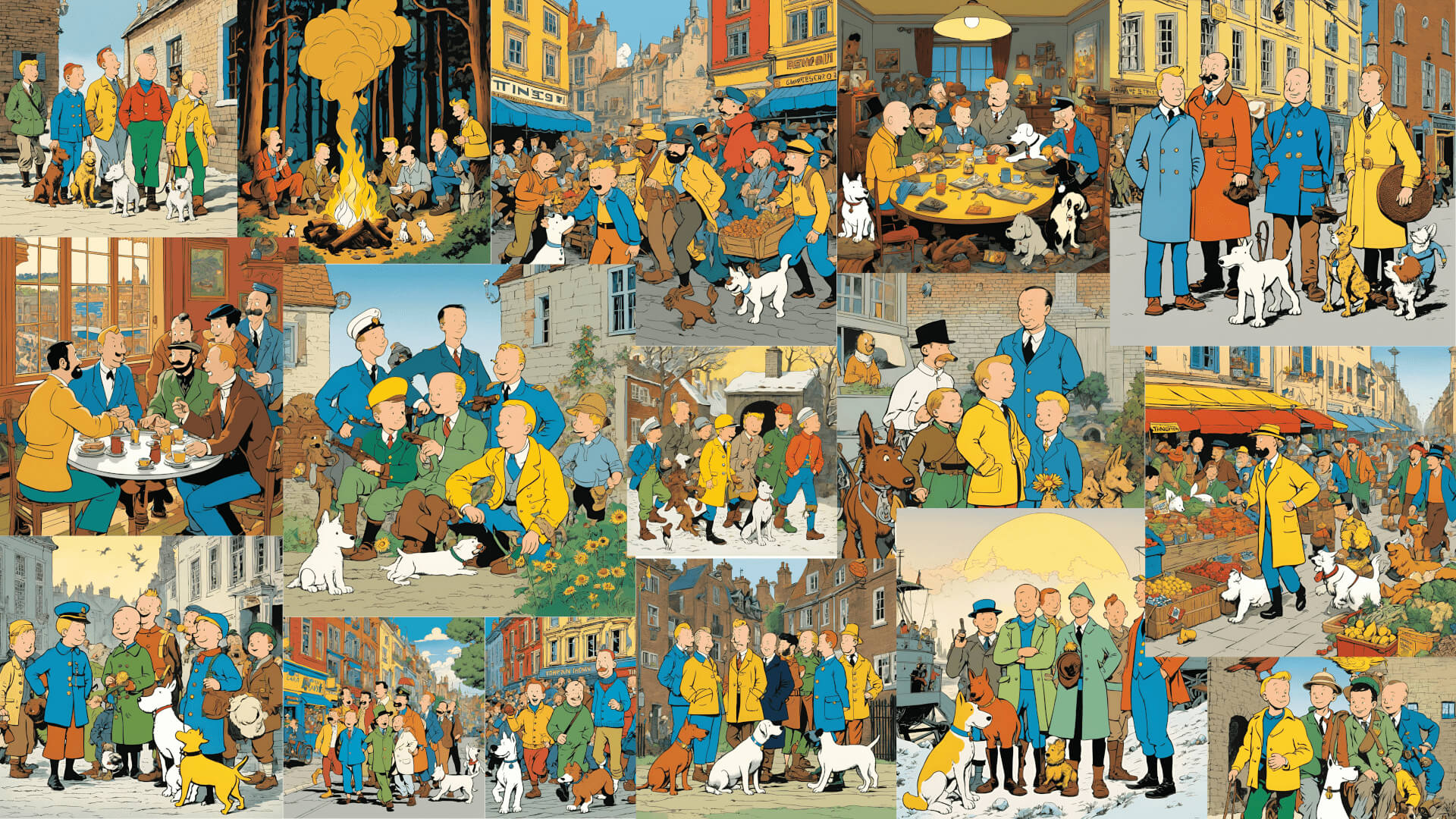
Tintin’s graphic style, often referred to as ligne claire (clear line), is one of the reasons why the series is so recognizable. The use of clean lines and simple colors allows for exceptional readability and smooth narration.
- Ligne claire is a minimalist style with sharp outlines and bright colors, which highlights the action without distractions.
- This style makes the albums accessible to a wide audience while conveying the expressiveness of the characters and landscapes.
- The backgrounds are meticulously designed, showing particular attention to detail, whether it’s the architecture of a city or the characters’ clothing.
How Can Tintin Enrich Your French Learning?
While Tintin is primarily a work of entertainment, it is also a valuable resource for learning French. With its rich dialogues, diverse vocabulary, and varied cultural situations, reading Tintin’s adventures is an excellent way to improve your French while discovering fascinating cultural elements.
Expand Your Vocabulary Through Dialogue
Tintin albums are filled with engaging dialogues that allow you to learn new words in a dynamic context. You will find both simple expressions and more technical terms related to themes such as adventure, science, history, or geopolitics.
- Vocabulary Examples:
- énigme (mystery): the word refers to a mystery to solve.
- péril (danger): a word that represents a risk.
- indices (clues): small pieces of information used to solve a problem.
- These words are often reused throughout the story, helping you remember them more easily.
Understanding Francophone Culture Through Tintin
Tintin’s adventures offer fascinating insights into different cultures and historical periods. Whether it’s explorations in China, travels in Africa, or geopolitical tensions in Europe, each album introduces specific cultural and linguistic elements.
- “The Blue Lotus” introduces Chinese culture and the political issues of the time.
- “Tintin in the Congo” represents the colonial image of Belgian Congo, an album that today sparks numerous debates.
- “Tintin and the Picaros” dives into the political realities of Latin America, with themes of revolution and corruption.
The dialogues, often filled with humor and irony, allow you to discover typically French expressions and situations.
Tintin Albums and Their Cultural Contexts
| Album | Cultural Context |
| The Blue Lotus | Influence of Chinese culture |
| Tintin in the Congo | Colonial vision of Belgian Congo |
| The Sceptre of Ottokar | Geopolitics of Eastern Europe |
| Tintin and the Picaros | Revolution and politics in Latin America |
Why Does Tintin Continue to Influence Comic Books and Popular Culture?
Although the last Tintin adventure was published in 1976, Tintin remains a popular hero whose impact far exceeds the realm of comic books. Why does this series continue to captivate audiences, even decades after its creation?
Tintin’s Influence on Modern Comic Books
Tintin paved the way for many comic book creators. His influence can be seen in numerous contemporary works.
- Tintin’s albums have inspired artists such as Joann Sfar and series like The Adventures of Blake and Mortimer.
- The adventure comic genre was largely redefined by Tintin, with a graphic style that is still imitated today.
Tintin in Popular Culture
Tintin’s adventures don’t just fill the pages of books; they also appear in cinema, television series, and exhibitions.
- In 2011, the film The Adventures of Tintin: The Secret of the Unicorn, directed by Steven Spielberg, brought Tintin to the big screen.
- Numerous exhibitions about Tintin are organized, offering fans a unique insight into the world created by Hergé.
Glossary
| French | English | Level |
| énigme | mystery, puzzle | B1 |
| péril | peril, danger | B2 |
| justice | justice | A2 |
| exploration | exploration | A2 |
| maladroit | clumsy | B1 |
Vocabulary
| Mot | Définition |
| 🇫🇷itinéraire | Le parcours ou le chemin prévu lors d’un voyage. Exemple : L’itinéraire de Tintin le mène à travers le monde. |
| 🇬🇧itinerary | |
| 🇫🇷découverte | Trouver ou explorer quelque chose de nouveau. Exemple : Chaque album de Tintin est une nouvelle découverte. |
| 🇬🇧discovery | |
| 🇫🇷quête | Recherche ou mission difficile et souvent dangereuse. Exemple : Tintin part toujours en quête de vérité. |
| 🇬🇧quest | |
| 🇫🇷conflit | Dispute ou guerre entre deux ou plusieurs pays. Exemple : Dans certains albums, Tintin se retrouve au cœur de conflits géopolitiques. |
| 🇬🇧conflict | |
| 🇫🇷méchant | Un personnage qui incarne le mal ou qui est un obstacle pour le héros. Exemple : Le méchant Rastapopoulos est souvent l’antagoniste de Tintin. |
| 🇬🇧villain | |
| 🇫🇷compagnon | Une personne qui accompagne un autre dans ses aventures. Exemple : Milou est le fidèle compagnon de Tintin. |
| 🇬🇧companion | |
| 🇫🇷territoire | Un espace ou une région géographique explorée ou contrôlée par un pays ou une personne. Exemple : Les territoires africains sont souvent explorés dans les albums de Tintin. |
| 🇬🇧territory | |
| 🇫🇷période | Une phase spécifique de l’histoire, souvent avec des événements particuliers. Exemple : Tintin vit dans une période marquée par des tensions internationales. |
| 🇬🇧period | |
| 🇫🇷révolution | Un changement radical et soudain dans la société, la politique ou l’économie. Exemple : Tintin explore des pays en pleine révolution. |
| 🇬🇧revolution | |
| 🇫🇷expression | Une phrase ou une manière spécifique de dire quelque chose. Exemple : Dans Tintin, de nombreuses expressions françaises sont utilisées. |
| 🇬🇧expression | |
| 🇫🇷allié | Une personne qui aide et soutient une autre dans un but commun. Exemple : Le capitaine Haddock est un allié fidèle de Tintin. |
| 🇬🇧ally | |
| 🇫🇷carte | Un dessin représentant un lieu ou une région. Exemple : Les cartes sont essentielles pour les explorations de Tintin. |
| 🇬🇧map |