Vocabulary to speak about the Tour de France in French
Every summer, France changes rhythm. Roads close, villages gather, cafés fill up early, and people talk about cycling, weather, mountains, riders, and jerseys.
In July, the Tour de France will take place over 20 stages, making it a wonderful opportunity to discover France through its landscapes, accents, and local culture.
For French learners, the Tour de France is more than a sports event. It is a perfect moment to hear real French, reuse useful vocabulary, and join everyday conversations.
What is the history of the Tour de France and why is it useful for French learners?
The Tour de France was first held in 1903. It was originally created to promote a French sports newspaper, but it quickly became a national tradition and one of the most famous cycling races in the world.
The famous yellow jersey, called le maillot jaune, was introduced in 1919 to identify the race leader more clearly. Today, it is one of the most recognisable symbols in international sport.
For French learners, this history is useful because French people often talk about the Tour as part of their shared culture. It represents:
- l’endurance – endurance
- la résilience – resilience
- les régions françaises – French regions
- un rituel de l’été – a summer ritual
During an immersion stay, these cultural references often become natural conversation topics at breakfast, during a walk, or while watching the news with a host teacher.
How do you say “bike” in French?
The most common word for “bike” in French is un vélo.
You may also hear:
| French | English |
| un vélo | a bike |
| une bicyclette | a bicycle |
| faire du vélo | to ride a bike |
| aller à vélo | to go by bike |
| un cycliste / une cycliste | a cyclist |
| le cyclisme | cycling |
| une course cycliste | a cycling race |
| un vélo de route | a road bike |
| un VTT | a mountain bike |
| une piste cyclable | a cycle lane |
Useful sentence:
J’aime faire du vélo le week-end.
I like cycling on the weekend.
What basic Tour de France vocabulary should you know?
Here are the essential words to understand and talk about the Tour de France.
| French | English |
| le Tour de France | the Tour de France |
| une étape | a stage |
| le départ | the start |
| l’arrivée | the finish |
| le parcours | the route |
| une équipe | a team |
| un coureur | a rider |
| le peloton | the main group of riders |
| une échappée | a breakaway |
| une montée | a climb |
| une descente | a descent |
| un col | a mountain pass |
| une chute | a crash |
| une victoire | a victory |
| le classement | the ranking / classification |
Useful sentence:
Le peloton arrive bientôt dans le village.
The peloton will soon arrive in the village.
What are the Tour de France jerseys called in French?
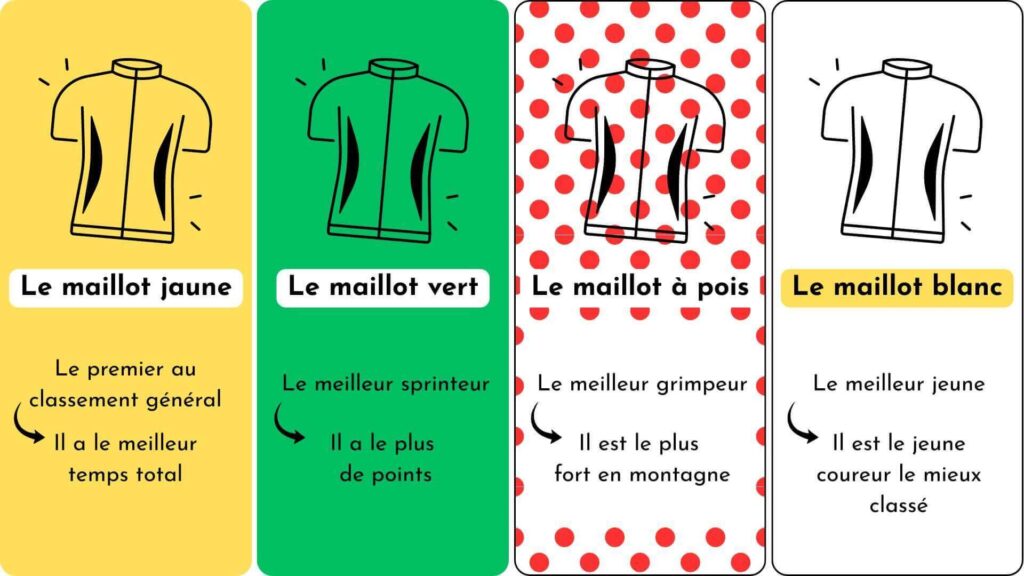
The jerseys are very important in the Tour de France. You will hear these words often on TV, on the radio, and in conversations.
| French | English |
| le maillot jaune | the yellow jersey |
| le maillot vert | the green jersey |
| le maillot à pois | the polka dot jersey |
| le maillot blanc | the white jersey |
| le leader | the leader |
| le meilleur grimpeur | the best climber |
| le meilleur jeune | the best young rider |
| le sprinteur | the sprinter |
| le grimpeur | the climber |
Useful sentence:
Le maillot jaune est le symbole du leader de la course.
The yellow jersey is the symbol of the race leader.
How can you talk about the atmosphere of the Tour de France?
The Tour is not only about sport. It is also about villages, families, roads, cafés, and summer traditions.
| French | English |
| l’ambiance | the atmosphere |
| les spectateurs | the spectators |
| la foule | the crowd |
| encourager | to cheer |
| applaudir | to clap |
| la caravane publicitaire | the publicity caravan |
| les cadeaux | gifts |
| une route fermée | a closed road |
| un village animé | a lively village |
| une fête populaire | a popular celebration |
Useful sentence:
Il y a beaucoup d’ambiance quand le Tour passe dans une ville.
There is a great atmosphere when the Tour goes through a town.
How can you give your opinion about the Tour de France in French?
To join a conversation, you do not need complicated grammar. A few simple opinion phrases are enough.
| French | English |
| C’est impressionnant. | It’s impressive. |
| C’est très populaire en France. | It’s very popular in France. |
| J’aime l’ambiance du Tour. | I like the atmosphere of the Tour. |
| Je ne connais pas bien le cyclisme. | I don’t know cycling very well. |
| Les paysages sont magnifiques. | The landscapes are beautiful. |
| Cette étape est difficile. | This stage is difficult. |
| Le coureur est très fort. | The rider is very strong. |
| Je préfère les étapes de montagne. | I prefer mountain stages. |
Useful sentence:
Je ne suis pas spécialiste, mais j’aime regarder les paysages.
I’m not an expert, but I like watching the landscapes.
What vocabulary can you use to talk about French regions during the Tour?
The Tour de France is also a journey through French regions. In 2026, the official route will visit several regions and departments in France, offering learners a chance to connect vocabulary with real places, accents, and landscapes.
| French | English |
| une région | a region |
| un département | a department / local area |
| un village | a village |
| une ville | a town / city |
| la campagne | the countryside |
| la montagne | the mountains |
| la mer | the sea |
| un paysage | a landscape |
| un accent régional | a regional accent |
| une spécialité locale | a local speciality |
In Provence, learners may talk about heat, landscapes, markets, and village life. In Brittany, conversations may focus on the crowds, the coastline, local identity, and regional pride. Around Paris, the Tour often becomes a topic connected to national symbols and major celebrations.
👉 Explore French regions before your trip with our resources on Provence, Brittany, and Paris.
What are some easy Tour de France conversation questions?
Use these questions to start a conversation with your teacher, host family, or French speaker.
| French question | English meaning |
| Vous regardez le Tour de France ? | Do you watch the Tour de France? |
| Le Tour passe près d’ici ? | Does the Tour pass near here? |
| Quelle est votre étape préférée ? | What is your favourite stage? |
| Vous aimez le cyclisme ? | Do you like cycling? |
| Qui porte le maillot jaune ? | Who is wearing the yellow jersey? |
| Est-ce que cette étape est difficile ? | Is this stage difficult? |
| Il y a beaucoup de monde aujourd’hui ? | Are there many people today? |
| Où est l’arrivée ? | Where is the finish? |
How to use all this vocabulary?
Learner: Vous regardez le Tour de France ?
French speaker: Oui, surtout les étapes de montagne.
Learner: Moi aussi, j’aime les paysages. C’est impressionnant !
How to use all this vocabulary?
What fun facts can help you speak about the Tour de France?
Fun facts are excellent for conversation because they are easy to remember.
You can say:
- Le Tour de France existe depuis 1903. → The Tour de France has existed since 1903.
- Le maillot jaune existe depuis 1919. → The yellow jersey has existed since 1919.
- Les coureurs font plus de 3 000 kilomètres. → The riders cover more than 3,000 kilometres.
- Ils brûlent beaucoup de calories chaque jour. → They burn a lot of calories every day.
- La caravane publicitaire distribue des cadeaux aux spectateurs. → The publicity caravan gives gifts to spectators.
- Quand le Tour passe dans un village, l’ambiance change complètement. → When the Tour passes through a village, the atmosphere changes completely.
Why is the Tour de France such a powerful moment to learn French in France?
During the Tour, learners hear the same words again and again: étape, coureur, arrivée, maillot jaune, montagne, victoire, classement.
This repetition helps learners understand faster and speak with more confidence.
You do not just study vocabulary. You hear it on TV, read it in newspapers, discuss it at the table, and use it in real situations.
That is the heart of immersion: French becomes connected to places, people, emotions, and memories.